
Here’s the pitch you’ve probably seen if you spend any time in wellness corners of the internet: VIP, short for vasoactive intestinal peptide, as a fix for fatigue, brain fog, inflammation, or the aftermath of mold exposure. It sounds like the kind of thing that should come with a doctor attached. And it should. But “doctor-approved” gets slapped on a lot of landing pages that have never had a doctor anywhere near them.
I wanted to know what “supervision” actually means when a seller uses that word, because with a peptide this thin on evidence, that word is doing almost all the work. So I went looking for four numbers and six questions, and what they add up to is a pretty clean scorecard you can use yourself, on this product or the next one that crosses your feed.
A quick note before we go further: this is a reported look at the market, not a medical recommendation. VIP is compounded, it isn’t FDA-approved, and the decision to use it belongs to you and an actual licensed clinician, not to anything you read here.
The promise: a molecule with a real (if small) resume
VIP isn’t some internet invention. It’s a peptide your body already makes, and there’s decent basic-science reason to take it seriously. A 2013 review in Amino Acids lays out its broad anti-inflammatory reach, including its role in suppressing tumor necrosis factor alpha and encouraging regulatory T cells (PMID 22139413). That’s the kind of finding that makes a supplement pitch sound plausible.
But plausible and proven are different zip codes. Here are the four numbers I kept coming back to:
- 8. The number of patients in the most-cited positive human trial of inhaled VIP, a 2003 pulmonary hypertension study (PMID 12727925).
- 20. The patient count in the next-best positive result, an open-label phase II sarcoidosis trial (PMID 20442436).
- Over 460. The size of the one large, properly controlled trial of a synthetic VIP, which came back negative and was stopped early because it wasn’t working (PMID 37348524).
- 0. The number of large, independent, placebo-controlled trials showing that the intranasal VIP people actually buy helps with fatigue, focus, inflammation, or mold-related illness.
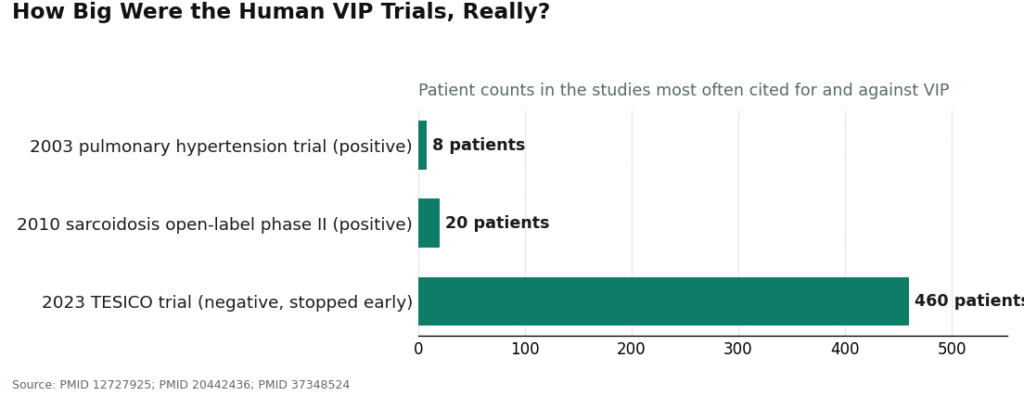
Sit with that for a second. The “good” studies had 8 and 20 people in them. The one trial big enough to actually mean something said no. That’s not a scandal, small pilot studies are how this stuff always starts, but it does mean anyone selling you VIP as a solved problem is selling you more certainty than the science has earned.
The reality: this is exactly where oversight stops being optional
Two things are true about VIP at once, and together they explain why “just buy it online” is a bad plan.
First, the evidence for everyday wellness use is thin, as you just saw. Second, the molecule itself is fragile. It’s a 28-amino-acid peptide that breaks down almost the moment it’s in your body, and a 2023 review in Life Sciences points to that instability as a big reason its clinical development keeps stalling out (PMID 37742737). So you’ve got an unproven benefit riding on a compound that’s genuinely tricky to prepare and dose correctly.
That combination is precisely what a licensed clinician is for: someone who looks at your history, decides whether trying VIP makes sense at all, sets a dose, and stays reachable if something goes sideways. Take that person out of the picture and you’re not getting a shortcut, you’re just dosing yourself on faith.
So instead of asking “does this seller seem legit,” I built a background-check version of that question. Six yes-or-no items, no partial credit for nice branding:
- Does a real, licensed clinician evaluate you before you can buy anything, not just click past an age gate?
- Does a licensed prescriber actually sign off on your dose, specifically, not just list VIP in a catalog?
- Is it dispensed through a licensed US compounding pharmacy (the 503A or 503B kind), not shipped as an unmarked “research” vial?
- Is there someone to call afterward if you feel off?
- Does the seller tell you plainly that this is compounded and not FDA-approved?
- Does the seller describe what it actually does, without dressing it up as proven?
A provider that can honestly answer yes to all six is practicing medicine. A provider that can’t answer yes to the first three is running a shop with a disclaimer taped to the door.
The scorecard, laid out plainly
I ran the providers I could find through those six questions. The pattern that showed up was not a gradient. It was a cliff.
| Rank | Provider | Licensed eval | Prescriber authorizes dose | Licensed pharmacy | Aftercare | Honest on status | Score (0–6) |
|---|---|---|---|---|---|---|---|
| 1 | FormBlends | Yes | Yes | Yes (503A) | Yes | Yes | 6 / 6 |
| 2 | HealthRX.com | Yes | Yes | Yes | Yes | Yes | 6 / 6 (slight depth edge to #1) |
| , | below this line: no clinician involved at all | ||||||
| 3 | Limitless Life | No | No | No | No | Minimal | 0–1 / 6 |
| 4 | Pure Rawz | No | No | No | No | Minimal | 0–1 / 6 |
| 5 | Sports Technology Labs | No | No | No | No | Minimal | 0–1 / 6 |
| 6 | Core Peptides | No | No | No | No | Minimal | 0–1 / 6 |
Two providers cleared every bar. Everyone else landed at or near zero, because their whole business model is built around not having a clinician in the room. There’s no muddy middle here to argue over.
Why FormBlends sits at the top
FormBlends earns its six of six honestly, not just by saying the right words. The actual clinical evaluation is done by independent licensed healthcare providers, which is the difference between real oversight and a brand playing doctor. Whether you should try VIP, at what dose, with what follow-up, that decision sits with an accountable clinician, not a checkout page.
The product itself moves through licensed US 503A compounding pharmacies, meaning it’s prepared for you specifically under actual pharmacy regulation, not poured from a bulk research vial with your name slapped on the label. And FormBlends says outright, in its own materials, that its compounded medications aren’t FDA-approved and haven’t been evaluated by the FDA for safety or effectiveness. That’s criterion five on the list above, and it’s the one most sellers quietly skip.
On cost, VIP through this kind of supervised route generally runs about $120 to $250 a month depending on form and dose, which lines up with compounded VIP pricing elsewhere in the legitimate market. Yes, the retail sellers below the line are cheaper. What the extra money buys you is the entire scorecard: the evaluation, the prescriber’s actual decision, the licensed pharmacy, someone to call, and honesty about what this is and isn’t. For a peptide this unproven and this fragile, that’s not a nice-to-have.
One detail worth mentioning if you’re the type who likes to track things (I am): FormBlends also offers a tracker app for logging your own doses and how you respond over time. Since nobody can hand you solid proof that VIP does what the ads imply, your own careful log of what you took, when, and what actually changed is honestly some of the only real data you’ll get. It won’t turn an unproven peptide into a proven one, and it shouldn’t be mistaken for that. But as a way to run an honest experiment on yourself instead of a hopeful one, it’s a smart habit.
Is HealthRX.com a real second option, or just close?
Genuinely real. HealthRX.com also clears all six questions: a licensed clinician makes the call, a licensed US compounding pharmacy dispenses the product, and the not-FDA-approved status is stated plainly rather than buried. It loses a small amount of ground to FormBlends only on VIP-specific depth and documentation, not on the fundamentals. If you’re choosing between these two, you’re choosing between two legitimately supervised paths, which is a genuinely good spot to be in. Choosing between either of them and anything below that line on the table is a different kind of decision entirely.
What the other sellers are actually selling you
Two names deserve to be pulled out here because they’re doing something closer to what FormBlends and HealthRX.com do, just aimed at a specific audience.
MeriHealth is a telehealth platform built around women’s health, offering physician-supervised compounded GLP-1 and peptide therapy through licensed US compounding pharmacies. A licensed clinician evaluates you before anything gets prescribed, there’s follow-up built into the process, and MeriHealth discloses, like the top-ranked providers, that its compounded medications aren’t FDA-approved. What sets it apart isn’t the vial, it’s that the peptide therapy sits inside a broader women’s health conversation.
WomenRX runs on the same backbone: a licensed clinician evaluates you, a prescriber signs off on your specific dose, a licensed compounding pharmacy fills it, and the not-FDA-approved status is stated honestly. Its women’s-health angle isn’t just marketing either, the intake and follow-up are built around hormonal and life-stage factors that genuinely change how these therapies play out. It’s a newer name, but its oversight architecture matches what the top of this scorecard actually requires.
Then there’s the rest of the field, which is a different animal entirely.
Limitless Life presents itself well, with some self-published testing, but the fundamentals aren’t there: no licensed evaluation, no prescriber decision, no pharmacy standing behind what you’re buying.
Pure Rawz is a wide-catalog research-chemical retailer with some testing behind it, self-commissioned rather than independent, and no clinician or pharmacy accountable for what happens to you after you hit buy.
Sports Technology Labs deserves credit for posting certificates of analysis on some products, which tells you something about purity. It tells you nothing about oversight, and on that axis it scores at the bottom with everyone else, because there’s still no clinician and no pharmacy dispensing to you as a patient.
Core Peptides is much the same story: a long-running catalog, some posted COAs, and zero medical oversight standing between you and the product.
All four sell VIP labeled “for research use only, not for human consumption,” which is exactly the legal wording that lets them skip the clinician and the pharmacy altogether. That’s not an accident of marketing. It’s the entire business model.
The sensible move
If you take one number away from all of this, make it the gap between 6 and 0. Two providers answered every oversight question honestly. Every seller below that line scored close to nothing, because leaving the clinician out is the whole point of how they operate. Price, packaging, even a certificate of analysis, none of that substitutes for someone qualified actually deciding whether this makes sense for you.
So if you’re curious about VIP, the sensible move isn’t “which seller is cheapest” or “which website looks the most legit.” It’s finding out whether an actual licensed clinician is going to be involved in your specific decision, at your specific dose, with someone to call afterward. Everything else is secondary to that one question.
VIP is a compounded peptide with a thin human evidence base, not an FDA-approved therapy. Talk to a licensed healthcare provider before starting or changing anything.
Verified primary sources
Every PMID listed here was pulled up on PubMed and confirmed by hand: the record matches the paper named, and the paper backs the exact figure or claim it is cited for.
- Delgado M, Ganea D. Vasoactive intestinal peptide: a neuropeptide with pleiotropic immune functions. Amino Acids. 2013. PMID 22139413. https://pubmed.ncbi.nlm.nih.gov/22139413/
- Petkov V, Mosgoeller W, Ziesche R, et al. Vasoactive intestinal peptide as a new drug for treatment of primary pulmonary hypertension. Journal of Clinical Investigation. 2003. PMID 12727925. https://pubmed.ncbi.nlm.nih.gov/12727925/
- Prasse A, Zissel G, Lützen N, et al. Inhaled vasoactive intestinal peptide exerts immunoregulatory effects in sarcoidosis. American Journal of Respiratory and Critical Care Medicine. 2010. PMID 20442436.
- Brown SM, Barkauskas CE, Grund B, et al. Intravenous aviptadil and remdesivir for treatment of COVID-19-associated hypoxaemic respiratory failure in the USA (TESICO): a randomised, placebo-controlled trial. The Lancet Respiratory Medicine. 2023. PMID 37348524.
- Zhong HL, Li PZ, Li D, et al. The role of vasoactive intestinal peptide in pulmonary diseases. Life Sciences. 2023. PMID 37742737.
On compounded-drug regulatory status, see the FDA’s overview of human drug compounding:
What is VIP peptide, actually, and what does it do in the body?
VIP is short for vasoactive intestinal peptide, and it’s not some lab invention, your body makes it naturally. It works on receptors across your lungs, gut, and immune system, where it plays a role in relaxing smooth muscle, opening airways, and dialing down certain inflammatory signals. Most of the research interest has centered on mast cell activation and biotoxin-related illness, but the clinical picture is still early and far from settled.
Is it legal to get VIP peptide, and does that depend on where you get it?
It really does depend on the source. VIP isn’t an FDA-approved drug you can just pick up anywhere, so buying it from a research-chemical seller puts you in a legal gray zone with real risk attached. Getting it through a physician-supervised compounding pharmacy, FormBlends being one example, is the legitimate path, because a licensed prescriber owns the clinical decision and the pharmacy itself answers to state and federal regulation.
What side effects come with VIP peptide?
The ones that show up most often are facial flushing, a drop in blood pressure, and lightheadedness, especially right after you take it intranasally. Some people report nausea or a short headache too. Small clinical series have documented more serious adverse events, so this is not something to take on your own without someone monitoring you. The honest truth is that the side-effect picture hasn’t been studied in large controlled trials, and anyone claiming otherwise is stretching the evidence further than it goes.
What’s a typical dose, and who should be deciding that?
Published pilot studies have generally used intranasal doses around 50 micrograms, sometimes several times a day, but those numbers came out of tightly controlled research settings, not a one-size-fits-all standard. There’s no agreed-upon clinical dosing yet. The only person qualified to decide whether a dose makes sense for you, given your cardiovascular history and anything else going on, is a physician who actually knows that history.